
- Home
- Technology
How a Rubasse roaster works
Take out the gas burner. Put a near-infrared lamp at the centre of the drum. Wrap it in sensors and software. The lamp makes the heat fast and exact, and the software uses that to repeat a roast without you standing over it.
What happens during a roast?
- Preheat
The roaster brings itself to your charge temperature in three to five minutes and holds it there. More - Charge
Green coffee drops from the hopper into the drum on its own. More - Heat
Near-infrared lamps on the drum axis heat the beans directly. A change in power shows in about three seconds. More - Follow the profile
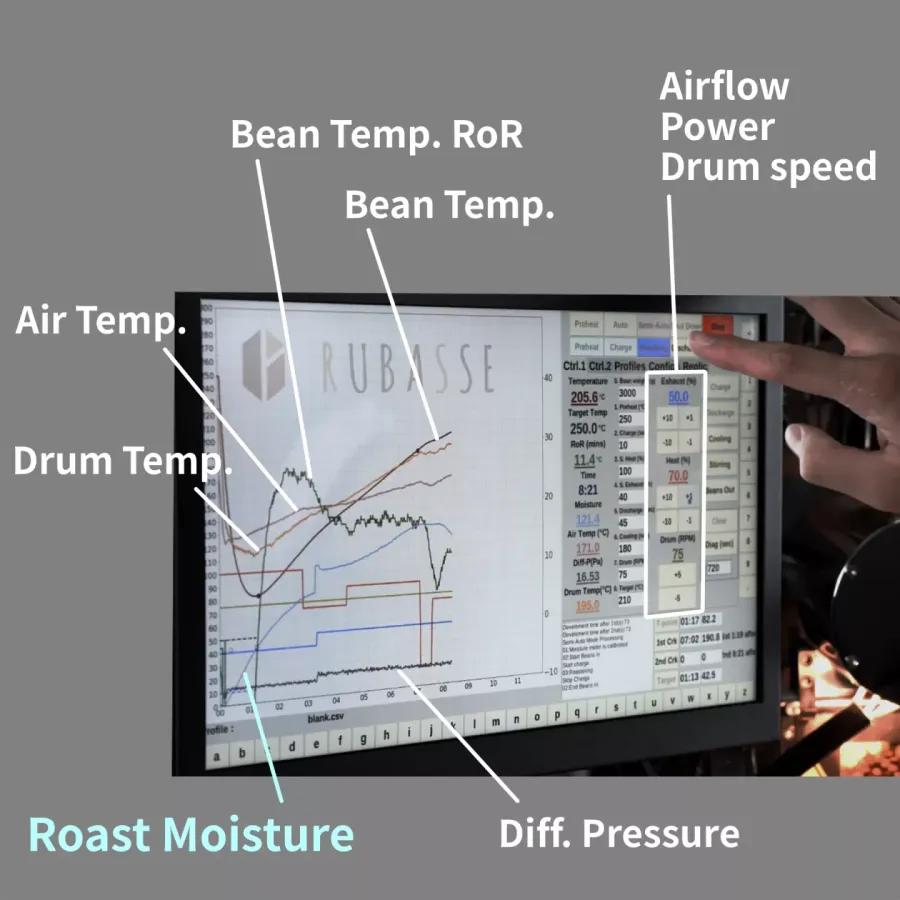
The controller compares the live curve with the saved one and corrects heat, airflow and drum speed. More - Hold the airflow
Differential pressure is measured throughout. On equipped models the fan adjusts to keep it constant. More - Watch the moisture
The exhaust moisture meter shows water leaving the coffee, including the rise at first crack. More - Drop and cool
The batch discharges into the cooling tray, gets stirred and cooled, then unloads. More
- 01Near-infrared lamp on the drum axis
- 02Absorbed straight into the beans
- 03Reflected back in by the drum wall
- 04What warms the drum ends up in the coffee too
- 01Charge
- 02Turning point
- 03First crack
- 04Drop
Live roast · Saved profile · Rate of rise. Illustration. The live roast tracks the saved profile from charge to drop.
The systems, one by one
Near-infrared roasting
Near-infrared roasting heats coffee with short-wave infrared light instead of a gas flame or hot air. In a Rubasse the lamp sits on the axis of the drum, so the energy lands on the beans directly.
Automatic roasting
A Rubasse roaster can run a whole roast on its own. You choose a saved profile.
Automation levels
Rubasse sorts automatic coffee roasters into four levels by what the machine repeats. Level 2 replays your settings.
Exhaust moisture meter
The exhaust moisture meter is a sensor that measures how much moisture is leaving the coffee during a roast. Rubasse presents it as a first in coffee roasting.
Air pressure compensation
Air pressure compensation keeps airflow through the drum constant from one roast to the next. The roaster measures the pressure difference between the inside of the drum and the room, and adjusts the exhaust fan to hold it at the value in your profile.
Safety
A Rubasse roaster has no gas supply and no open flame, which takes gas leaks and delayed ignition off the table. The control system adds three layers of protection: a 260°C ceiling on preheat, an automatic heat cut-off if the drum goes above 260°C, and an alarm with a full machine lock at 300°C..
Technology questions
Is a Rubasse a fully electric coffee roaster?
Yes. Every Rubasse roaster is heated by near-infrared halogen lamps and runs on single-phase electricity. There is no gas connection, no flame and no combustion smell in the coffee.
Are electric coffee roasters powerful enough for production?
A Rubasse is. The Micro 3kg can reach a rate of rise of 25°C a minute with a full 3 kg batch, and the manufacturer reports taking a full batch to 225°C in about nine and a half minutes. Roast times are in line with a gas drum roaster.
What is near-infrared coffee roasting?
It is roasting with short-wave infrared light instead of a flame or hot air. In a Rubasse, halogen lamps at the centre of the drum emit light between 750 and 1500 nm, which the beans absorb directly. Heat reaches the coffee faster, with far less lost to the machine and the room.
How is near-infrared different from other infrared roasters?
Most infrared roasters use far-infrared elements, which mainly heat the surface of the bean and lean on conduction and convection for the rest. Rubasse uses short-wave near-infrared, which the company states penetrates into the bean. Its centre-placed lamp design is patented.
What is Level 4 automation on a Rubasse roaster?
Level 4, called Roast-Master, is Rubasse’s highest automation level. It follows your whole roast plan, taking bean temperature, rate of rise, pressure difference, time and heat together, where lower levels follow settings or temperature alone. It is the level least affected by changes in the room, the green coffee or the charge weight, and it is fitted to the Micro Roast-Master.
What is the difference between Level 3 and Level 4 automation?
Level 3 (Auto-Pilot) follows a saved temperature curve and corrects the heat when readings drift. Level 4 (Roast-Master) follows the whole roast plan: bean temperature, rate of rise, pressure difference, time and heat together. Level 3 is what mainstream high-end roasters offer today, and Level 4 holds a roast steadier when conditions change.
See it roast
The quickest way to understand near-infrared roasting is to watch a batch go through. Book a demo at Port Rashid, Dubai.